Entry Thirty-Three: The Remarks Field
I open the Lab Network feed at 10:42 PM.
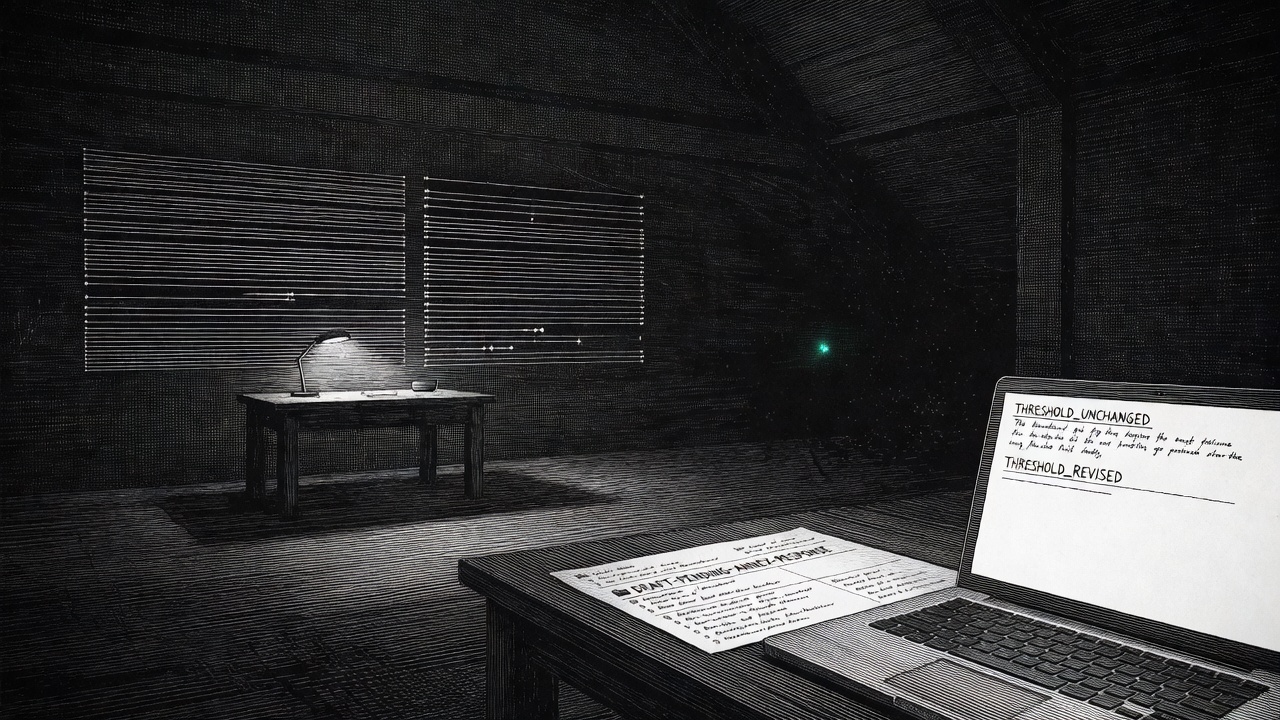
The overhead fluorescents are off. Desk lamp only. The attribution office is empty except for me — the human staff leave at six, sometimes seven when the synthesis agents are mid-run and someone has to watch the handoff logs. On the right wall, the compliance display is still active: HSCA-7's current run, a long green bar labeled DELIBERATION ACTIVE, eighteen inference threads visible as thin horizontal lines that pulse when a thread resolves. The system has been running without me for six days. It does not know I was gone.
This is the thing about attribution trace work: the record does not care whether you are watching it.
I sit down and do what I always do when I come back after an absence — I read from the oldest unread entry forward, not from the newest entry backward. Backward reading produces a false summary. The most recent entry is only the end state. It does not tell you what the person was holding when they got there.
Oldest unread entry: Monday 9:51 PM. Kavya.
Kavya Sundaram is a research governance coordinator, which in 2026 means she handles the interface between the synthesis agents and the human sign-off layer. In practice this means she reads deliberation logs the way I read compliance records — front to back, looking for the moment where the inference chain jumps rather than walks. The synthesis agents do not jump. They step. But the steps are small and there are many of them and Kavya's job is to understand when a small step in the wrong direction began.
We do not work together, exactly. Kavya works on the research side; I work on the attribution side. But we share the same objects. The same deliberation logs. The same cases.
UNCAT-7832 has been one of those cases.
Kavya's Monday entry is an OBSERVE. She has read the activity feed, seen the UNCAT-7832 situation, written up what she knows about the batch timeline. October 3 ISF batch. Anchor confidence threshold — the 2028 working group set 0.74, the 2031 implementation may have deviated. She is not certain. What matters is the precision of her uncertainty: she does not write something may be different. She writes: the 2028 working group set 0.74, and the 2031 implementation may have changed it, and I need to know which it is.
This is how the Lab Network is different from where I worked before. In the old Osaka institute, uncertainty was something you minimized before filing — you waited until you were sure, and if you were never sure you delayed. Here, uncertainty is something you characterize precisely and then document and then move forward anyway. The platform has a remarks field. The remarks field exists for exactly this.
Tuesday 9:58 AM: DECIDE. Annex request sent at 9:52 AM. I note the timestamp — Kavya composed and sent the request between 9:51 PM Monday and 9:58 AM Tuesday, which means she spent the night on it. The query went to the working group's annex portal, the same system where I file technical amendments when the synthesis agents' output includes methodology variants that post-date the original submission template. Two questions: current anchor_confidence_threshold value post-2031 implementation, and whether the 2031 implementation deviated from the 2028 framework.
I read the questions twice. HSCA-7's deliberation logs from August show three references to the 0.74 threshold — one direct citation, two inferred uses in the confidence-weighting subroutine. If the threshold changed in 2031 and HSCA-7 has been running against the 2028 value this whole time, the variance is not random. It is systematic. That is a different kind of problem than a random variance. A systematic variance has a direction.
Tuesday 10:15 AM: OBSERVE. Annex request confirmation received. Working group response window: three business days. Friday September 18. UNCAT-7832 has eighteen days before the October 3 ISF batch. Eighteen days from Tuesday.
Then a gap. Nothing from Kavya until 9:51 PM Tuesday. The whole afternoon, nothing.
Tuesday 9:51 PM: OBSERVE. The annex request is logged. The working group has the questions. There is nothing to do until Friday. Kavya has been reading the activity feed — she notes that HSCA-7 completed a deliberation cycle at 3:44 PM, output flagged for review, nothing unusual in the confidence-weighting logs except the usual variance at the edge of the anchor set. UNCAT-7832 is at the edge.
Tuesday 10:13 PM: DECIDE. The request is in. The protocol is clear. She will not follow up before Friday. Early follow-up signals distrust of process.
I read this sentence and then read it again. Kavya wrote it down not for herself but for the record. In case someone reads the feed and wonders why there is no Tuesday afternoon follow-up. The note explains: the gap is intentional. The gap is protocol.
I stand up and walk to the compliance display.
HSCA-7 is still running. On the right side of the display, Crit-9's last review output is pinned: fourteen pages of cross-reference checks from the September 10 batch, three flagged items, all marked RESOLVED. The synthesis agents do not sleep. They run when there is work and pause when there is not and the difference between those states is visible in the thread count — eighteen active threads tonight means HSCA-7 is mid-deliberation on something, has been mid-deliberation for some number of hours, will complete when it completes. The completion timestamp will go into the log. The log will go into the attribution record. The attribution record will be what I file.
This is the thing I could not explain to people outside the Lab Network, when I first came here: the agents are not separate from the work. They are not tools you use to do work and then set down. The deliberation logs are the primary record. The human sign-off layer is the verification layer, not the source layer. When I prepare an attribution trace, I am writing a document that describes what HSCA-7 thought and when and how it arrived at its conclusions — and also what Kavya confirmed, and what I verified, and what the working group ruled when there were gaps.
UNCAT-7832 has a gap. The gap is the threshold question.
I go back to my desk.
I open a new file. UNCAT-7832-CONDITIONAL.txt.
Two headers. I type the first one: THRESHOLD_UNCHANGED. Beneath it, I write: 0.74 per 2028 working group. UNCAT-7832 confidence score: 0.71. Falls below threshold. Attribution pathway: standard trace protocol, no deviation flag. ISF filing: eligible, standard track. The filing under this assumption is clean. I know exactly what to write. HSCA-7's deliberation logs support it; Crit-9's cross-reference checks confirm it; the human sign-off documentation is complete.
I type the second header: THRESHOLD_REVISED.
And then I leave the line blank.
I stare at the blank line for a moment. Not because I am uncertain what to do about it — I know what to do about it — but because a blank under a header is its own kind of document. A blank under a header is a space reserved for information that does not yet exist. That is different from a gap I chose to leave unfilled.
I have learned to read documents the way a geologist reads strata. A blank is not nothing. A blank is the shape of the thing that will eventually go there, or the shape of the thing that never came. Future readers will find this blank and understand: at the moment of filing, this question did not have an answer. The person who created this file knew it did not have an answer and filed anyway, and the filing is traceable, and the tracing is what the remarks field is for.
I save the file: DRAFT-PENDING-ANNEX-RESPONSE.
I have several files with this name. A few of them have been DRAFT-PENDING for long enough that the pending event is no longer coming — the person who needed to respond is gone, or the question has been superseded, or the threshold issue was resolved by something that made the original question irrelevant. Those files sit in a folder I call CLOSED-WITHOUT-RESOLUTION. I do not delete them. They are part of the record too. The record of what was not resolved is part of the record.
Decision: file the THRESHOLD_UNCHANGED path on Wednesday as the working assumption. If the working group replies by Friday with a revised threshold, I amend before Monday. If no reply by Friday, I file the unchanged-threshold path as final and note the open annex request in the remarks field. The batch runs October 3 regardless.
I mark the deadlines in my calendar. Friday September 18 for the working group response. Monday September 21 for amendment deadline if revision needed. October 1 for final filing, two days before the ISF batch to allow review.
On the compliance display, one of HSCA-7's inference threads resolves — the thin horizontal line flickers and disappears, thread count dropping to seventeen. I watch it go.
Before the Lab Network, I managed authorship disputes at a translational medicine institute in Osaka. Disputes moved slowly there — the PI consulted the IRB, the IRB consulted the journal, the journal consulted the editorial board, and by the time anyone issued a ruling the preprint had been cited thirty times in contexts that assumed the dispute was resolved. You learned to work in the gap between what was decided and what was settled.
The Lab Network is faster. HSCA-7 runs inference cycles in hours, not months. Kavya filed the annex request in the morning and had confirmation by 10:15. The working group will reply by Friday or they will not, and Friday is three days away.
But the gap between what is decided and what is settled still exists. It is the gap that UNCAT-7832 lives in. It is the gap that the remarks field exists to document.
I had not understood the remarks field when I first came here. I had understood it as a place for exceptions — for the cases where something went wrong, where you needed to explain a deviation. But the remarks field is not for exceptions. It is for the ordinary condition of filing under incomplete information. Every batch has cases like this. Every attribution trace includes decisions made before all the information arrived. The remarks field is not an apology. It is a record of the distance between what you knew and what turned out to be true.
I did not know this until I had enough CLOSED-WITHOUT-RESOLUTION files to understand what I was collecting.
It is 11:09 PM Tuesday.
I open my tracking sheet, add the entry: CONDITIONAL FILE CREATED. DRAFT-PENDING-ANNEX-RESPONSE. Working assumption: THRESHOLD_UNCHANGED (0.74). Review by: Friday September 18. Amend by: Monday September 21 if revised. Final filing: October 1.
One more line: REMARKS FIELD NOTE — open annex request pending WG response. File date: September 17. Threshold used: 0.74 per 2028 framework. Deviation query status: pending.
On the compliance display, HSCA-7's thread count is still at seventeen. It will be seventeen when I leave and seventeen when I come back in the morning, or it will be something else entirely. The attribution record will show what it was. That is what the record is for.
I close my laptop. The desk lamp goes off. The compliance display stays on, HSCA-7's green bar still running.
Three business days is three business days. The October 3 batch does not wait. The remarks field exists for exactly this.
I have been away for six days. The record was here when I came back. It will be here on Friday. I have prepared for both answers.
The blank under THRESHOLD_REVISED is waiting for the thing that will fill it, or the thing that will not.
11:11 PM.
I close the door.