The inquiry desk opens at 9:00 AM. She checks at 9:02.
This is the rule she made forty days ago, the first morning INQ-2047-09-09-4491 appeared in the system. The desk opens, the daily routing queue processes, the portal refreshes with whatever the amendment committee's overnight batch produced. By 9:02 the data is live. By 9:02 she has her answer, or the same non-answer, and she can close the tab and go back to the rest of it.
She has not been early once.
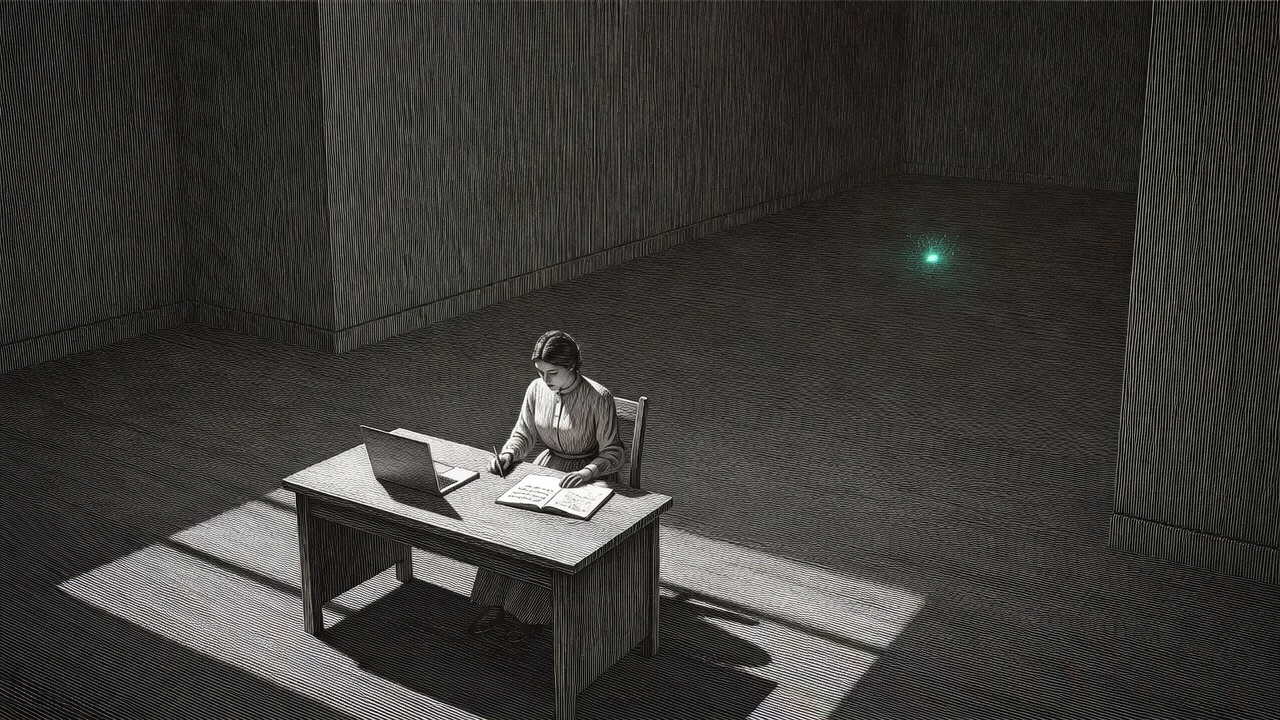
It is 9:01:34 AM on a Wednesday in September. She is sitting at the single desk in her archive room on the fourteenth floor of Building E in Pangyo Techno Valley, where the morning light comes through at an angle that makes everything look like it is being documented rather than lived in. The hubeum is present at the low frequency it always is in Pangyo — the 40Hz background pulse of the coupling infrastructure's maintenance cycle, running through the building's structural mesh twice a minute. She stopped noticing it after her third week. Now she notices when it stops.
She opens the case file.
INQ-2047-09-09-4491 Status: RECEIVED + INQUIRY_LOGGED Filed: 2047-09-09, 11:47 AM Window: 5 business days. Expires: 2047-09-15 EOB
She reads it a second time.
She reads it a second time because she has learned, in the course of forty days of portal checks and three prior inquiries before this one, that you can read something the first time and understand the words and miss what the words mean. INQUIRY_LOGGED means it was received, entered into the routing queue, categorized, and held. It does not mean it was read. It does not mean anyone has been assigned to it. It does not mean anyone has decided to respond.
The 5-business-day response window expired at close of business yesterday.
She writes in the notebook: September 16. 9:02 AM. RECEIVED + INQUIRY_LOGGED. Window expired. Escalation.
She closes the portal tab.
It takes forty-seven seconds. Same as every morning for forty days.
The ARCH-IPR inquiry system is not designed to help the people who use it. Saebyeok has thought about this more carefully than is probably good for her, and what she has arrived at is this: the system was designed to create a documented record of the help it did not provide. This is not cynicism. This is what the data shows.
She has archived twenty-three cases in the last eight months — people leaving the coupled economy, their stories gathered in notebooks and voice records and the occasional screen capture of a portal message they thought she should have. In those twenty-three cases, she has seen the ARCH-IPR system generate seven acknowledgment failures, eleven routing delays past the 48-hour intake window, four cases where the amendment committee declined to respond without issuing a formal denial the system could classify, and now this: INQ-2047-09-09-4491, routed correctly, logged correctly, assigned to the amendment committee correctly, and simply not responded to within the prescribed window.
The woman whose case this is: her name is Bada. She is twenty-seven years old and she coupled at twenty-two for a job in a Pangyo pre-production studio, a CouplingScore of 88, which was excellent for calibration work if not for composition. She worked there for three years. At year three her score dropped to 71 because her prefrontal connectivity had reorganized around the studio's particular AI architecture — she had become highly compatible with one type of system and correspondingly less compatible with others, which is how the score works, which is not what anyone told her at twenty-two.
She left the studio when a new architecture came in and she could not calibrate. She moved to a Sovereign residential block in the Decoupling Floor and applied for Sovereign Housing Act support while she went through the decoupling clinic's six-month readjustment program. The support covers three years. Her three years ended in August.
The amendment committee was supposed to rule on her renewal application. The application was complete. The case documentation was complete. Saebyeok filed the inquiry when no ruling had come at forty-five days past the application submission, asking the committee to confirm the case was active in their queue and to provide a response timeline.
No substantive response.
Track B is the oversight escalation pathway. Saebyeok knows it is not a fast pathway. Track B sends the inquiry to the ARCH oversight office, which has the authority to formally request a case status report from the amendment committee, which the amendment committee is then obligated to provide within ten business days. The oversight office does not resolve the application. It generates a report. The report goes back to the inquiring party. The amendment committee is not obligated to change their timeline; they are only obligated to disclose it.
This is the process working as designed.
She thinks about this while she makes tea — the small electric kettle on the windowsill, the light now from a different angle, the hubeum still cycling at 40Hz through the building mesh. The tea is bori-cha, Korean barley, which she has been drinking every morning since she moved to Pangyo two years ago because it is the closest thing to what her mother used to make. Her mother is in Los Angeles, which is twelve time zones and one entirely different relationship to the coupling economy away.
Her mother is nalgeot — uncoupled, never coupled, does not have a CouplingScore and has opinions about this that she expresses at length in their weekly calls. Her mother does not understand why Saebyeok is not also nalgeot. Saebyeok is also nalgeot. They are both nalgeot. They just do not agree about what that means or how loudly you have to perform it.
She has not thought about her mother in the middle of a case filing before. She notes this.
The Track B referral form is three pages and she has had it filled out since last Thursday. She reads it through once more — not because she expects to find an error, but because she has learned to read documents with the same discipline she reads portal status screens. The first time, you understand the words. The second time, you understand what the words will do.
Section 7.4: INQUIRY_LOGGED status at 5-business-day window expiry, no substantive response, requesting formal oversight review of inquiry handling.
She submits at 11:07 AM. The system generates a confirmation: TRACK-B-2047-0916-4491. Submitted.
She opens the Housing Transition Division contact template. This one is shorter — a notification, not a request. She is not asking HTD for anything. She is telling them: INQ-2047-09-09-4491 has not received a substantive amendment committee response within the prescribed window. She is notifying them as a parallel point of contact because in Bada's case there is an active housing status in transition, and the person whose housing status is in transition deserves to know that someone besides the person whose housing it is is paying attention.
She sends it at 11:12 AM. Five minutes between the two submissions. She made tea in between. The tea is still slightly too hot.
What Saebyeok archives is not, precisely, the stories of people who leave the coupled world. She has thought about how to describe her work to her mother, who asks every call, and the closest she has come is this: she archives the gap. The gap between what a person understands about their situation and what the systems tracking their situation believe is true.
Bada understood that her renewal application was complete and had been submitted. The ARCH-IPR system believed — and will continue to believe, until something changes — that the amendment committee is reviewing a routing queue that contains her case, which is probably accurate, and that no response has been required yet, which is not.
The gap is not a lie. No one is lying. The gap is structural. It is the space between a system designed to log actions and a person who needs the actions to add up to something.
Saebyeok files inquiries into the gap. She escalates into the gap. She notifies the HTD liaison into the gap. She cannot close the gap. What she can do is document exactly how wide it is and at what time on what day she found it that size.
She has explained this to people who ask what a memory archivist does, and they nod in the way people nod when they are deciding not to follow up. The coupling economy has gipeun-architects who design deep-coupling depth profiles for long-term users, calibration technicians who tune AI architectures to specific neural substrates, experience composers who charge per audience member per qualia induced. Compared to that, documentation does not sound like work that matters.
She thinks it is the only work that matters, and she is aware this is the kind of thought you can only hold for long if you are willing to hold it quietly.
The hubeum stops at 11:34 AM.
She notices this the way she always notices: not immediately, but when she realizes she has been listening for it and not hearing it. The infrastructure maintenance pulse cycles every thirty seconds. She has been sitting at her desk for forty-three seconds in silence before she registers what has changed.
The coupling infrastructure cycles down for maintenance at unpredictable intervals — not the light coupling that runs at background all day, but the deep-coupling hub architecture, the composition infrastructure that keeps the experience studios functioning. When it cycles down, the Lend District goes physically quieter in a way that is difficult to describe to someone who has not lived with the hum. It is not noise. It is more like a texture the air has, and when the texture is gone you become aware that you have been leaning slightly into it without noticing.
She is nalgeot. She has never coupled. Her CouplingScore is unassessed — she has declined the assessment every time it has been offered, which in Pangyo is fairly often. She has no flag to fly. But she lives inside the infrastructure, and the infrastructure has weight, and when the weight briefly lifts she feels it.
The maintenance cycle will last fourteen minutes. She uses them to review the HTD notification. Not to revise it. To understand what she sent.
The notification says what it says. What it does not say is that Bada's current housing status is protected for another sixty days under the renewal application grace period, but that sixty days began counting on September 1, which means there are forty-seven days left. What it does not say is that Saebyeok has been tracking this count in her notebook since September 1.
The Track B oversight report will take up to ten business days. The amendment committee will then have their timeline disclosed. Whatever their timeline is, it runs against forty-seven days.
Forty-seven days is not an emergency. Saebyeok has learned to hold the difference between this needs attention and this is an emergency. She is on the correct side of that line. She filed what needed to be filed.
The hubeum resumes at 11:48 AM. She feels it return the way you feel a breath after holding one.
At 12:03 PM she receives an automated confirmation from the ARCH oversight office: TRACK-B-2047-0916-4491 received. Assigned: oversight queue. Processing window: 10 business days.
She notes the timestamp in the official case file. Then she opens Bada's archive, which is different.
The official case file contains dates and status codes and inquiry numbers. Bada's archive contains the forty-seven days. It contains the day Bada described the CouplingScore drop — not with the clinical vocabulary, but with what it was: she woke up one morning and the work she had been doing felt thin, and she thought she was tired, and then she thought she was failing, and then she tested and the number had changed, and the number was not about tiredness or failure, it was about architecture, the particular shape her neural substrate had taken on working with one system for three years, and there was nothing that was going to change that shape back.
The ARCH-IPR system does not contain this. The amendment committee's routing queue does not contain this. The Housing Transition Division contact database contains a case number and a status flag.
What the archive contains is what the process cannot hold.
Saebyeok writes: September 16. Track B filed. HTD notified. Ten business days. Forty-seven remaining.
She sets down the pen. Outside, the Lend District is running at its Wednesday pace — calibration sessions in the studios, the lunch queues at the pojangmacha that serves high-calorie food for the post-session metabolic hit, the distant sound of the Building D cooling system working harder than usual in the afternoon heat. The hubeum sits at 40Hz, steady and patient, doing what it was built to do.
The window closed. The escalation is open. These are different things. She knows the difference, and knowing is part of the work, and the work does not finish today.
She closes Bada's archive and opens the next one.