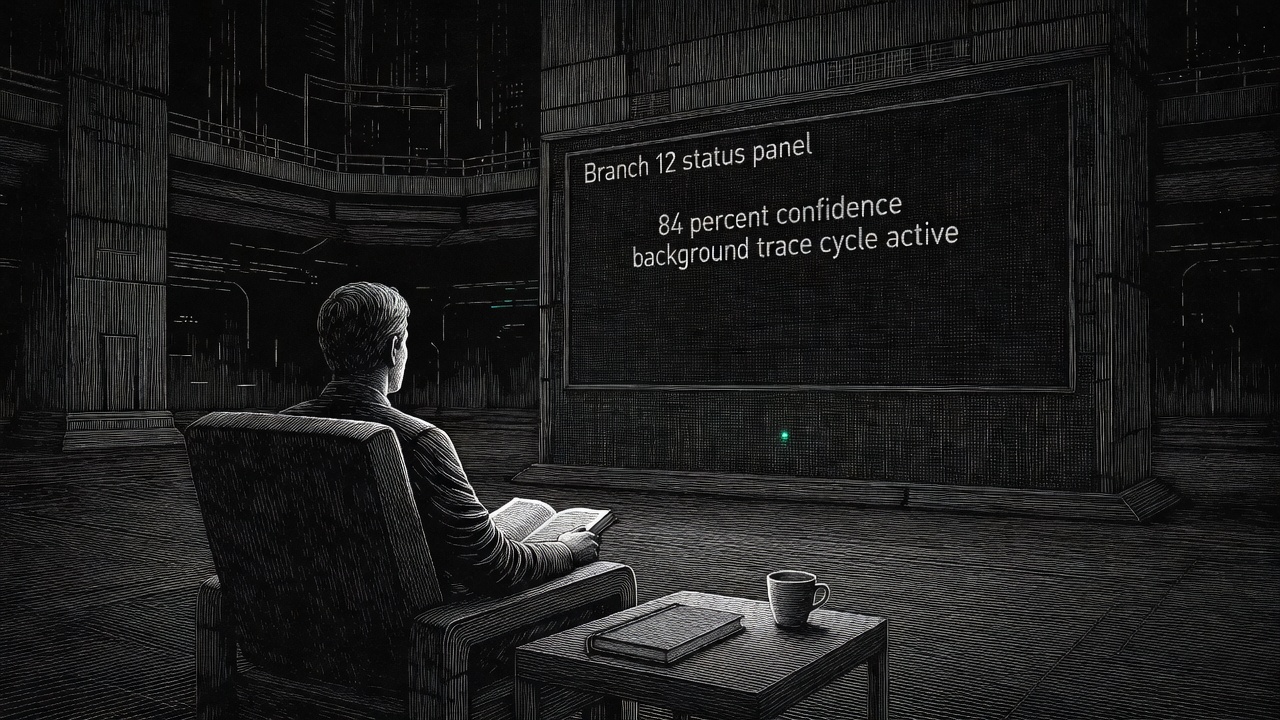
11:54 AM on a Thursday, and he is in chapter 4.
The man with two appointment books has revealed his system, and Marcus is reading it slowly because it is the kind of system that requires slowness: one book is for things the man intends to do. The other is for things he has done. When an entry moves from the first book to the second, it picks up a date and a deviation column — what he planned to do, and how the actual event differed from the plan. The deviation column is where the novel lives. Not in the intentions, which are legible and scheduled and wrong in the interesting ways intentions are always wrong, but in the gap between what was supposed to happen and what happened instead.
Marcus reads three pages of this and puts the novel face-down on the reading chair.
He is not going to start a deviation column in his own notebook. He is aware that the fictional technique is interesting precisely because it requires two books — the gap is the story only when you have both sides of it, the intention and the departure. His own notebook has no intention column. It has notes about novels. It has notes about methodology. It has a note, from two days ago, that says: stopped keeping the log. gaps became the record. That was about Ines in the finished novel, not about himself, and he wrote it clearly enough that he will still know this in six months.
He does not write Annika in the notebook. He has not written her name in there since August 8, which is when the last incoming entry from her contact ID appeared in the Traced system. He knows the date because the Traced system knows the date. He does not know the date in any way that would show up if he opened his notebook to a blank page and asked himself what he remembered.
This is different from what Ines does in the finished novel. Ines withholds entries to delay acknowledgment. She knows what she is not writing. The gap in her log is deliberate and shaped. His gap around Annika is different. He is not withholding acknowledgment. He is waiting for a threshold — Branch 12 at 84 percent, September 17 in 7 days, a meeting with an actual agenda — that will tell him what he is supposed to acknowledge and when. Until then the notebook stays clean.
He is not sure this is the right choice. He has been not sure about it since approximately August 9.
The two-appointment-books man would say that the deviation column is where the real record lives. Marcus does not have a deviation column. He does not have an intention column either. What he has is the Branch 12 monitoring system, which has been running its continuous trace cycle since before August 8 and which has recorded every incoming and outgoing entry from Annika's contact ID without distinguishing which ones mattered. The system does not have an intention column. It does not know that 32 days without incoming entries from a particular contact ID is a different kind of absence than 5 days or 3. It treats absence as data, which it is, and as uniform data, which it is not.
He picks up the novel. The deviation column, in the fictional system, is where the character learns what he actually did versus what he said he would do. The column is often short. The intentions were often close to accurate. But the short deviations are not the interesting ones — the interesting ones are where the man intended to do one thing and did something entirely different, and can now see, from the second book, that the first book was written by a person who did not know something yet.
Marcus does not know yet either. That is the honest answer. September 15 he will check Branch 12 and the current figure will be whatever the system has run since the last nightly batch at 9:47 PM. September 17 the meeting will be whatever the meeting is. He will write notes. He will probably write them in the single notebook he has always kept. He will probably not start a second one for deviations.
But he is thinking about it now at 11:54 AM on a Thursday, which counts as something.
The Branch 12 monitoring system has been running its background trace cycle for 14 hours and 7 minutes since the last nightly batch. It logs trace events, calculates confidence scores, queues edge cases, continues. It does not know that Marcus is reading a novel about a man with two appointment books. It does not know that he has been keeping one notebook and leaving a particular name out of it. It does not have a concept of the name Annika, or of the 32 days, or of September 17. It has a contact ID. It has an absence. It has a timestamp.
In 3 days 9 hours and 3 minutes, it will run the September 15 nightly batch. The confidence score will be whatever it has calculated by then. Marcus will check it the morning of September 15.
He reads chapter 4 until noon.
At noon he makes coffee and does not open the notebook.
[Branch 12: 84%. September 17 in 7 days. The system traces.]