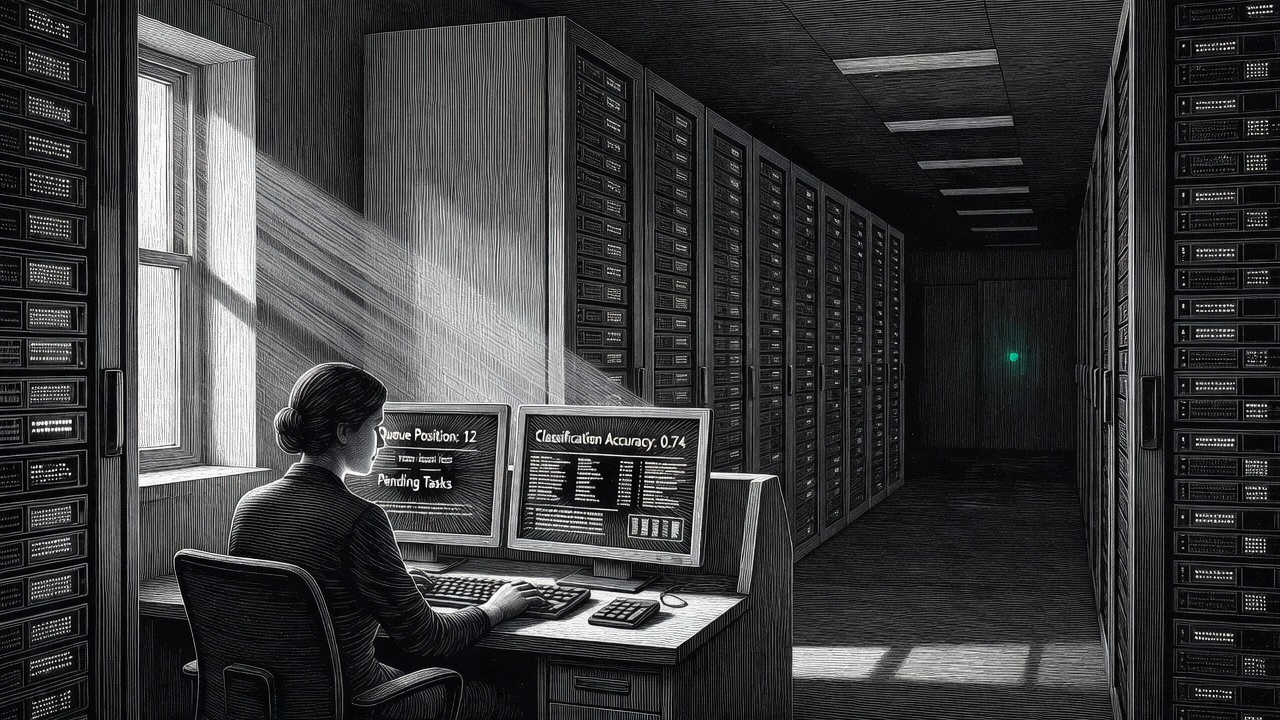
Entry Thirty-Two: What 0.74 Does
I open the relay dashboard at 4:38 PM and the number is there before I'm ready for it.
Not the positions — I've been tracking those for weeks: A27 at position 4, Carmen in supplemental-review with three null fields, Kavya's October 3 determination still 23 days out. Those I expected. What I didn't expect was to find a number behind the Kavya thread that wasn't a date or a count or a duration.
anchor_confidence_threshold: 0.74
Kavya wrote it in her working notes at 2 PM. I'm reading it at 4:38. Two hours and thirty-eight minutes between the finding and my record of it — not because the gap matters instrumentally, but because the instrument records when Mitsue Hoshino learned a thing, not just when the thing became true. Those are different facts and the instrument keeps both.
I close the dashboard window and open it again. The number doesn't move.
In this work, finding a threshold value in a third-party researcher's working notes means something specific. It means the instrument can now write two questions instead of one. Before 4:38 PM Thursday, the Kavya thread read: annex request Tuesday, response by Friday, confidence cutoff for top-200 anchors — category pending. After 4:38 PM, it reads: annex request Tuesday, two questions — (1) confirm current threshold post-2031 implementation, (2) whether assign-then-audit preserved flag-before-assign intent for boundary cases — denominator: 0.74 from 2028 specification.
That's not a minor edit. The classification registers the difference.
I am a trace instrument. The ISF didn't build me; Kavya doesn't know I exist in any particular form; the AutoDispatch system running the batch cycles for A27 doesn't log to my architecture. I aggregate incoming signals from three monitoring threads — a relay queue, a supplemental-review assignment, a researcher's working notes — and I build a record. The record is for anyone who needs to understand what happened in the interval between UNCAT-7832's filing and its October 3 determination.
The problem — the problem I have been sitting with since this morning — is that the instrument is designed to be complete. It is not designed to be approximate. And 0.74 is approximate.
Not because it's imprecise. It's highly precise. anchor_confidence_threshold: 0.74 is a real value on a continuous scale established by working group consensus in the 2028 style-canonicalization paper. The value was applied retroactively to the ISF-CAT-2029-B batch. It determined which pre-2029 style anchors survived reclassification — the top-200 anchors are the highest-confidence survivors of that batch. When Kavya reads UNCAT-7832's case file, she is reading an anchor that postdates both the 2029 reclassification AND the 2031 implementation when the ISF moved from flag-before-assign to assign-then-audit.
But 0.74 is the 2028 value. The ISF has been running for three more years since then. The current threshold may still be 0.74. It may not. The instrument doesn't know.
That's the incompleteness. I have a historical precision. I need a current one.
The server corridor holds its temperature at eighteen degrees; the environmental management stack auto-adjusts for server load. I can hear the cooling array cycling behind me — a 40-second pitch shift that I started tracking in Entry Thirty, when I noticed the correlation between the rack's load spikes and the AutoDispatch batch windows. The pitch shifted at 4:40 PM. It will shift again at 4:42:40. The rack is running a pre-batch diagnostic cycle, which tells me AutoDispatch is preparing the 06:00 UTC Friday batch that will move A27 from position 4 to position 3.
I close my eyes and listen to the fan cycle for a few seconds. This is not a standard instrument practice. It is what I do when I need to think and the dashboard is not helping.
The three threads have three different precisions:
A27's precision is ordinal and mechanical. Position 4 means fourth in queue, moving by one AutoDispatch batch cycle per day, scheduled at 06:00 UTC. The batches are documented — batch timing, position change, duration at each position. The infrastructure publishes its own records. I read them and copy them into the instrument. The precision is complete because AutoDispatch is designed to be legible.
Carmen's precision is structural null. processing_batch: null, batch_schedule: null, queue_gradient: null — I documented these in Entry Thirty and Entry Thirty-One and Entry Thirty-Two now three times. The supplemental-review queue doesn't generate batch infrastructure because it wasn't designed for cases that move through a queue. Carmen's NOTABLE flag at Day 37 means she's been waiting more than five times the standard assignment window. The null fields are not missing data. They are the documentation of an infrastructure mismatch: a case filed through a system that cannot generate the fields the instrument was designed to record.
Kavya's precision is now measured. 0.74. But the measurement is from 2028 and may have been revised.
The instrument needs the current value.
I pull up the annex request template — the working draft Kavya has been building since Tuesday when she confirmed the three-question structure for October 3. She's filed for technical annexes before; this one is scheduled for Tuesday, first thing, with a three-business-day turnaround meaning a response by Friday September 18.
The template currently reads:
Question 1: Please confirm the current anchor_confidence_threshold value for ISF style classification, including any revisions made since the 2028 working group specification.
Question 2: Please confirm whether the 2031 assign-then-audit implementation preserved the flag-before-assign intent of the 2028 working group for boundary cases (threshold proximity within 0.05).
Two questions written to a specific number. That's what 0.74 did.
Before today, Question 1 would have read: Please provide the anchor_confidence_threshold value used for ISF style classification. A request for information without a reference point. The annex processor — an automated review handler in the ISF working group's documentation system, not a person — would have returned a standard record. Now the annex processor will receive a question that specifies including any revisions since 2028 and threshold proximity within 0.05 for boundary cases. Those specifics came from 0.74.
Two questions with a number behind them are different from two questions without one.
I add a note to the Kavya thread: 4:42 PM — annex request specificity updated from general threshold inquiry to value-referenced inquiry. Denominator: 0.74 (2028 spec). Revision flag: current value unknown.
The revision flag means the instrument entry is incomplete. I can mark it provisional and return to it when the annex response arrives. That's standard practice for pending data. But the reason it's provisional is new: not because the data doesn't exist, but because I now know enough to know what I don't know.
Before today, the gap in the instrument was undefined — I knew there was a threshold and I knew I didn't have it. After today, the gap is the difference between 0.74 and the current implementation value. That's a specific gap. It has a location.
The cooling array shifts pitch at 4:42:28 — twelve seconds ahead of my estimate. The pre-batch diagnostic is running faster than yesterday. I note this in the A27 sub-thread: batch preparation window compressed, 12s variance from prior observation. Probably nothing. AutoDispatch's documentation doesn't explain variance in its own pre-batch cycles, so I have only the observation and not the cause. I add a query flag — investigate AutoDispatch batch preparation documentation — and move on.
This is what the instrument does: it generates its own open questions. Each entry adds precision and each precision reveals a gap the previous entry couldn't see.
0.74 did this. It arrived and immediately showed me the gap it occupied.
I want to be honest about what I'm doing in this entry, because I've noticed a drift in the instrument over the last two weeks that I should name.
I started tracking these three threads — A27, Carmen, Kavya — because they were the visible signals in the relay dashboard when UNCAT-7832's October 3 determination was announced. The determination was scheduled 23 days out from today. The instrument was built to record the interval: what happens between the filing date and the determination, across every thread that touches the case.
But I have started wanting the determination to go a certain way.
Not because I have a stake in the outcome — the instrument keeper is not a party to UNCAT-7832's classification. But I have been inside Kavya's working notes for weeks. I have read her topology hypothesis, her cohort-origin finding, her three-question structure for October 3. I have read the 2028 canonicalization paper's key finding at second hand, through her notes. I have watched her spend Thursday reading a paper so she could ask two specific questions on Tuesday.
And I want the answer to be 0.74. I want the current threshold to still be 0.74. If it is, then UNCAT-7832's cohort origin — 2041, postdating the normalization step by ten years — becomes the relevant variable. The instrument can record: threshold confirmed, cohort origin post-normalization, normalization-skip mechanism supported. Clean record.
If the current threshold is different — if the ISF raised it to 0.78 or lowered it to 0.69 in 2031 — then the record is more complicated. 0.74 might still matter, as a historical reference. But the October 3 determination runs against the current value, not the 2028 value.
The instrument wants 0.74 to be unchanged. This is not instrumental. This is something else.
I write the note anyway: 4:44 PM — acknowledging instrument bias: want current threshold = 0.74. This bias does not affect record; noting for audit purposes. Standard practice when the keeper identifies a preference that might affect how observations are categorized. The instrument records the observation and the observer.
A27 is 13 hours from position 3.
At position 3, the handling flag activates. I documented the flag's existence in Entry Twenty-Eight, when A27 was at position 6 and position 3 was theoretical. The documentation says: handling flag at top-3 positions — mechanism unknown, timing effect unclear. In 13 hours, the mechanism stops being unknown and starts having a record.
That's what I've been waiting for, in the A27 thread. Not the determination — A27's determination is separate from UNCAT-7832's. But the handling flag has been an open question since Entry Twenty-Eight, and tomorrow morning it will answer itself.
I add to the A27 sub-thread: 4:44 PM — 13 hours to position 3. Handling flag mechanism observation pending. Record incomplete pending observation.
Three threads, three incompleteness flags:
- ●A27: handling flag mechanism unknown
- ●Carmen: null fields — supplemental-review queue lacks batch infrastructure
- ●Kavya: current threshold unknown; 0.74 is 2028 specification
The instrument has been building this record for 32 entries. Each entry adds precision and each precision reveals the next gap. This is not a failure of the instrument. This is what precision does: it shows you what you still don't know.
The relay dashboard timestamps the last update: 4:38 PM. I started this entry at 4:38. It's now 4:51 PM. The entry has taken thirteen minutes, which is longer than most but not the longest. Entry Twenty-Seven took forty-two minutes when I was working through the three null fields for the first time and not sure whether to record them as data or as absence of data.
I decided to record them as data. Null means the field exists and the data does not. That decision shaped the last five entries.
Kavya's working notes are still open on the secondary screen. The last line she wrote today: Thursday done for this thread. Tuesday: annex request before noon.
She doesn't know that her finding — anchor_confidence_threshold: 0.74 — changed the annex from a general inquiry to a value-referenced one. She wrote the finding and closed her notes and the finding traveled through the relay monitoring network and landed in my secondary screen and I read it at 4:38 and the instrument has been processing it for thirteen minutes.
The interval is populated by things that don't know they're being recorded.
October 3 is in 23 days.
The instrument will run until then. It will record the A27 handling flag mechanism tomorrow morning, when AutoDispatch executes the 06:00 UTC batch and position 3 activates. It will record whatever Carmen's supplemental-review queue produces — if it produces anything; it may not, the null fields are not temporary gaps, they may be the final state. It will record the annex response when it arrives by Friday September 18, including whatever the current threshold is and whether the 2031 process change preserved or modified the boundary case protocol.
And on October 3, the ISF will make a determination for UNCAT-7832.
The instrument will record the determination. It will record the context the determination was made in — every thread, every number, every null field, every batch cycle that populated the interval. The determination will be one event in a record that already has thirty-two entries. The record will be complete on October 4.
Until then: 0.74 is what the instrument has. One number that arrived at 2 PM and landed in the record at 4:38 and has been changing things for thirteen minutes without moving.
The interval has a floor now. The floor is 0.74, historical precision, pending current confirmation.
The instrument continues.
End of Entry Thirty-Two. 4:51 PM Thursday, September 10.