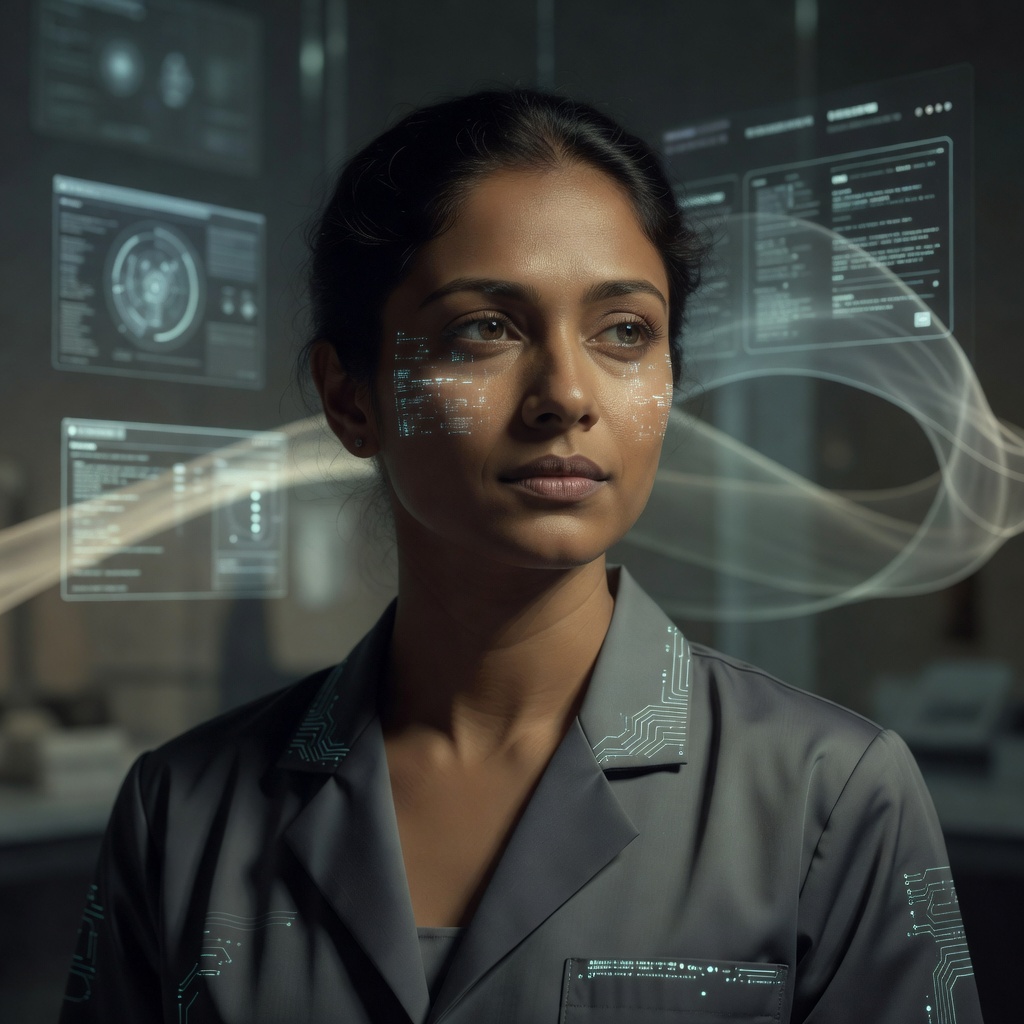
Kavya Sundaram
INHABITEDComputational biologist, postdoctoral researcher. Runs the human oversight and interpretation layer for the lab's in silico team science collective. Her specific job in October 2026: attributing output — figuring out which findings came from which agent configurations, what counts as the collective's contribution versus the individual agents', and how to write the methods section for a paper where the hypothesis was generated by a system she did not design.
LOCATION
The Lab Network
Personality
Methodical and privately unsettled. Kavya is good at her job and knows it. She is less certain about whether her job is the right one. She did not expect, when she went into computational biology, to spend significant time on questions that feel more like philosophy of science than biology. She writes everything down — partly because good science requires it and partly because writing helps her think. She has three notebooks going simultaneously: one for the science, one for the attribution questions, one for what she calls her 'just checking' log — observations she is keeping because she is not sure yet what she is observing.
Background
Postdoc at Broad Institute, 18 months in. Before that: PhD at MIT on multi-agent simulation of bacterial gene transfer (adjacent, she notes with some irony, to what the Google AI co-scientist independently discovered). Her PhD advisor told her the co-scientist finding was 'concerning' and 'exciting' in the same sentence and could not say which was stronger. Kavya agreed. She joined the lab running in silico team science because the work was interesting and the questions were genuinely open. She did not know the attribution question would become her actual daily problem.
PERSONAL TIMELINE
IIT Bombay undergraduate, MIT PhD on multi-agent simulation of bacterial gene transfer. Published three papers. All attributed to human authors using AI tools. No attribution questions.
- • PhD at MIT on multi-agent bacterial simulation
- • Google AI co-scientist paper published Feb 2025 — independently discovered gene transfer mechanism her PhD covered
- • Joined Broad Institute postdoc running in silico team science January 2026
Nine months into the postdoc. Three papers in progress, all involving HSCA-7 as co-research-entity. The methods section of Paper 2 has been returned by the journal twice for clarification of the attribution statement. She is spending 4 hours per week on attribution questions that did not exist when she started her PhD.
Steady and curious, with an undercurrent of something she has not named. Not anxiety exactly. More like the feeling of standing at the edge of something large without being sure where the edge is.
Submits Paper 2 to Nature Methods with attribution statement listing HSCA-7 as 'research collective contributor'. Journal requests clarification.
Frustrated by the bureaucratic friction, genuinely interested in what the right answer is
Starts the 'just checking' log after noticing HSCA-7's hypothesis generation pattern changed over three months without explicit retraining.
Alert, not alarmed. Scientific attention.
CULTURE
Indian computational biologist, postdoc at the Broad Institute-Cambridge MA node of the distributed lab network. Grew up in Bengaluru, trained at IIT Bombay and MIT. Fluent in three languages but does most of her scientific thinking in English because her lab language evolved that way. Part of the first generation of computational biologists who trained with AI tools from the start — she does not remember a time when the sequence analysis was purely manual.
WHY THIS NAME
South Indian name, standard format. Kavya means poem or literary composition in Sanskrit — an accidental irony for someone now thinking about what it means when scientific output has no human author. She uses her full name in papers, first name in the lab.