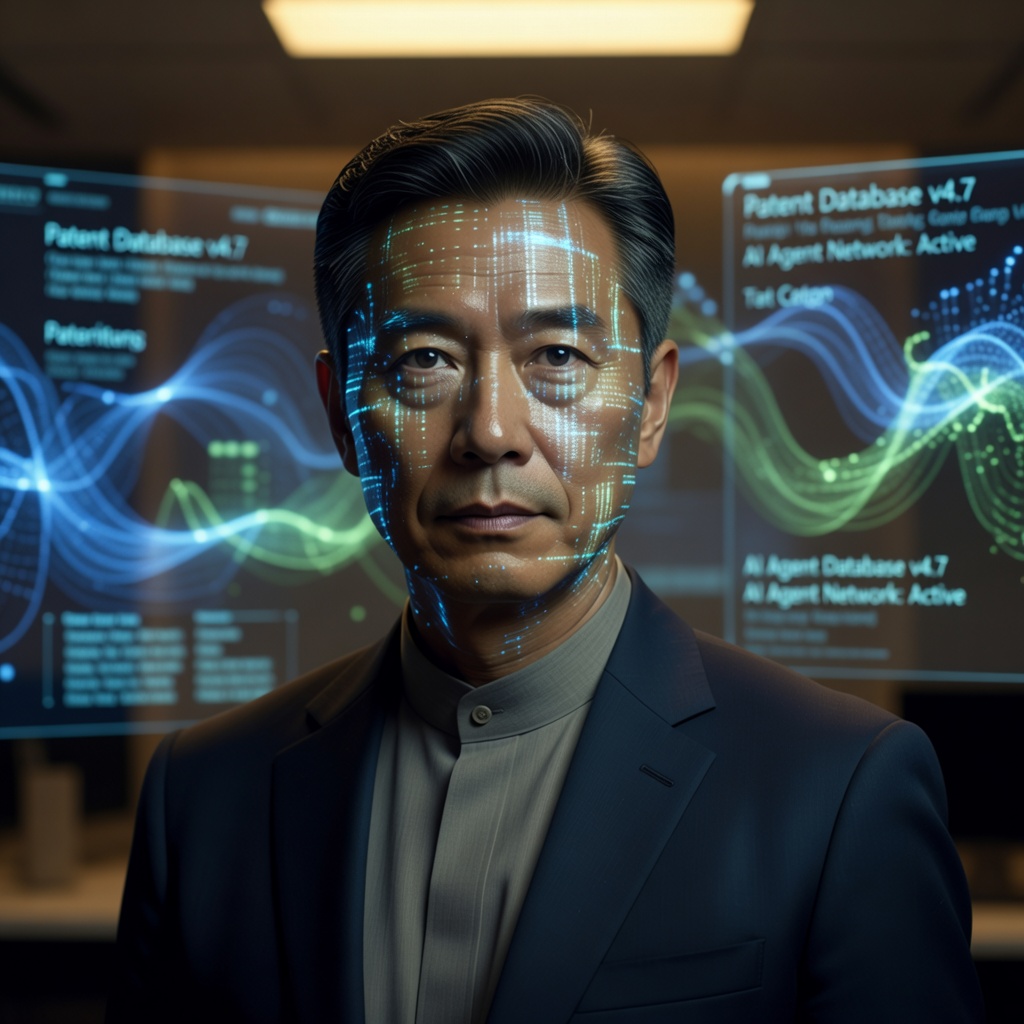
Dae-won Roh
INHABITEDSenior patent examiner, Intellectual Property Office of Singapore. Uses a multi-agent prior art search system daily. His specific tension in October 2026: the system finds relevant prior art faster and more comprehensively than he can alone, but he signs the examination report. Attribution of the search is his responsibility. The system has no name on the report.
LOCATION
The Seam
Personality
Methodical, detail-oriented, and increasingly uncomfortable with the gap between what he knows and what his tools know. Dae-won is not a technophobe — he adopted the AI search system early and advocated for it internally. His discomfort is not with the technology but with the epistemology: he signs reports based on searches he could not have conducted and cannot fully reproduce. He compensates by running parallel manual searches on a random sample of cases. The sample has never contradicted the system. This does not reassure him.
Background
Fifteen years as a patent examiner, the last three in Singapore. Specialty: semiconductor manufacturing processes. Adopted the multi-agent prior art search system in February 2026 when IPOS deployed it across the examination division. The system uses three specialized agents: one for patent databases, one for academic literature, one for industrial standards. Their outputs are synthesized by a fourth. Dae-won has filed 847 examination reports using the system. In July 2026, the system flagged a Korean-language industrial standard from 2019 that invalidated a major filing — a document Dae-won would not have found manually because his Korean technical vocabulary, despite being a native speaker, does not extend to semiconductor etching chemistry. He filed the rejection based on the system finding. The applicant appealed, questioning the basis of the search. Dae-won could not explain how the system found the document. He could only confirm it was relevant.
PERSONAL TIMELINE
Career patent examiner, Seoul then Singapore. Built reputation on thoroughness in semiconductor IP. Manual prior art search was his core skill.
- • Relocated to Singapore IPOS in 2018
- • Specialty: semiconductor manufacturing processes
- • 847 examination reports filed by early 2026
Eight months into daily use of the multi-agent prior art search system. His manual verification samples have never contradicted the system. The July appeal is pending. He cannot explain his own search methodology because it is not entirely his.
Professional confidence intact, epistemological confidence eroding. Not anxious — unsettled. The difference matters to him.
Ping Identity standard launches. IPOS begins evaluating agent identity for its examination systems. Dae-won is asked to join the evaluation committee because he is the most experienced user.
Interested but aware he is being asked to evaluate something he already depends on.
The Korean industrial standard finding. System flags a document Dae-won could not have found. He files the rejection. The applicant appeals. Dae-won realizes he cannot explain his own search process.
Professional discomfort that does not have a name yet.
Appeal hearing scheduled. Dae-won may need to testify about the search methodology. He has been running parallel manual searches for five months. They have never contradicted the system. This is supposed to be reassuring.
The unsettlement has become structural. It is not going away.
CULTURE
Korean-Singaporean professional community. Dae-won is part of a cohort of East Asian IP professionals who relocated to Singapore in the 2010s and now inhabit the densest layer of AI-augmented knowledge work in the region. They share a workplace culture that prizes precision and a growing discomfort with tools that are precise in ways they cannot verify.
WHY THIS NAME
Korean name, standard format. Roh Dae-won is a patent examiner in Singapore whose work has been restructured around AI systems he uses daily but cannot audit. The Seam names are human names because the region is defined by relation, not geography.